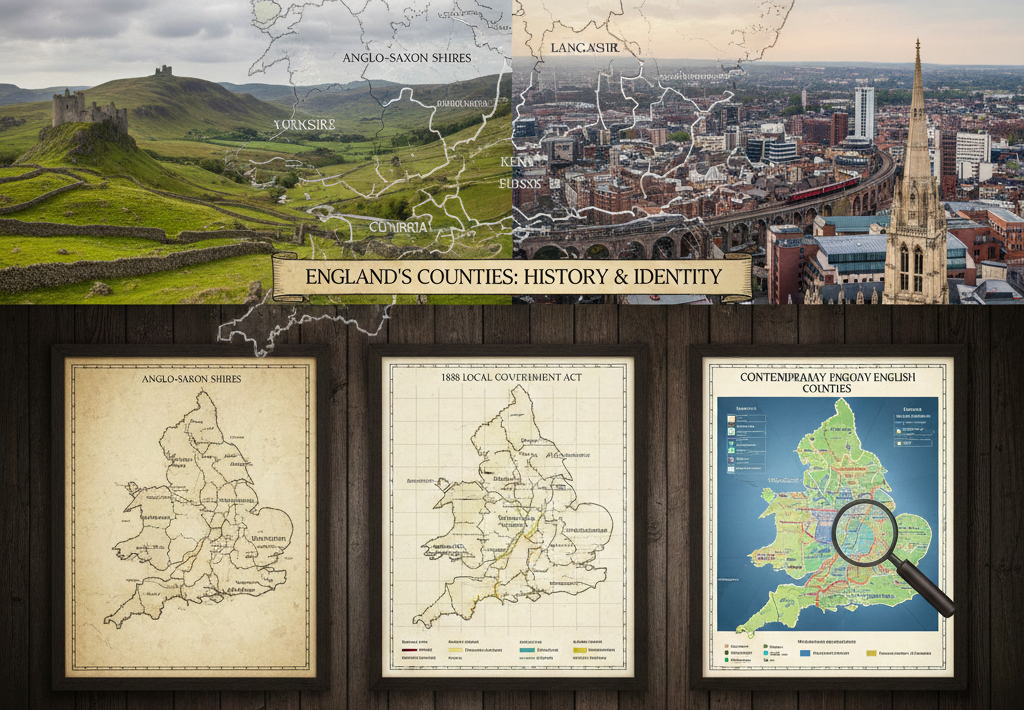
England’s counties play an important role in its history, governance, and regional identity. If you’re wondering how many counties there are in England, the answer depends on how we categorize them. The Office for National Statistics and various historical records provide definitions and figures, helping to distinguish between historic counties, ceremonial counties, and administrative counties. These distinctions are essential for understanding the historical and contemporary organization of England.
The total number of counties changes depending on whether you’re considering modern administrative units or historic regions. As detailed by experts from sources like the Historical County Borders Project, counties have evolved over time, and the number can vary depending on the context in which the term “county” is used.
Table of Contents
General Information About Counties in England
A county in England traditionally refers to a geographic area that forms the administrative unit for local governance. According to the UK Government’s Office for National Statistics, counties have historically been used to define territorial boundaries and organize resources like education and law enforcement. Over the centuries, the definition and role of counties have evolved, influenced by changes in local governance and legislation.
The number of counties in England can be fluid. Ceremonial counties, such as those identified by the Boundary Commission for England, are used for certain civic functions, including the appointment of Lord-Lieutenants. In contrast, administrative counties, which are primarily for local government use, may have different borders. Historical sources, including Parliamentary records, can help us understand how and why these distinctions exist.
Types of Counties in England
There are several types of counties in England: historic counties, ceremonial counties, and administrative counties. Historic counties, such as Yorkshire and Lancashire, have long-standing historical significance, with their boundaries reflecting medieval divisions. These counties are important in understanding the social and cultural evolution of England, as noted by historians from institutions like The National Archives.
Ceremonial counties are those that are recognized for ceremonial purposes and used for the organization of royal functions, such as the appointment of Lord-Lieutenants. These counties align with geographical boundaries, but they don’t always correspond with modern administrative divisions. As outlined by UK Government records, ceremonial counties reflect the historical legacy of earlier regions while continuing to serve civic roles today.
Shire Counties in England
Many counties in England include the word “shire,” and these are often referred to as shire counties. The term “shire” comes from Old English, meaning a division of land, and is often associated with rural areas. According to experts from the Oxford English Dictionary, “shire” was used to describe an area with administrative or judicial significance in early Anglo-Saxon England.
Examples of shire counties include Yorkshire, Hampshire, and Nottinghamshire. These counties are deeply connected to England’s medieval past. Their historical significance is emphasized in texts like the Domesday Book, which provides records of land divisions after the Norman Conquest. The continuation of the term “shire” highlights the enduring legacy of these regions and their important role in England’s historical narrative.
Regional Breakdown of Counties
England is geographically diverse, with distinct regions that are home to various counties. The North of England includes counties like Cumbria and Northumberland, regions known for their natural beauty and rugged landscapes. As noted in geographic studies by English Heritage, these counties are more rural and have smaller populations compared to more industrialized regions in the South.
The South of England is home to densely populated counties such as Kent and Sussex. These areas are often associated with economic development, housing important commercial and transport hubs. The differences between Northern and Southern counties reflect England’s historical evolution and the diverse ways in which its regions have developed over centuries, as explored in regional studies published by the Royal Geographical Society.
FAQs About Counties in England
One of the most frequently asked questions is about which counties in England have a city. According to official government records, certain counties like Greater London, Greater Manchester, and the West Midlands have cities that serve as economic and cultural hubs. In contrast, counties like Cumbria and Shropshire do not have a city, reflecting their more rural or suburban nature. This distinction is significant for understanding the role of counties in England’s urban and rural divide.
Another common question is about landlocked counties. As defined by the Ordnance Survey maps, landlocked counties like Leicestershire and Bedfordshire lack direct access to coastlines. This geographical feature has practical implications, affecting trade and the economy. For example, coastal counties like Cornwall or Kent have greater access to international trade routes, which historically influenced their economic development.
The Role and Purpose of Counties in England
Counties have long played an essential role in the governance of England. According to the UK Local Government Association, counties help organize local government services, including education, transportation, and law enforcement. They provide an administrative structure for delivering public services and serve as the basis for democratic governance at the local level.
Additionally, counties hold significant cultural and social importance. The term “county” often conveys a sense of regional identity, with people identifying strongly with the county they live in. As noted by The English Tourist Board, many counties are known for their unique traditions, historical landmarks, and local festivals, which contribute to their distinct cultural heritage.
Map and Visual Information
Maps are an excellent tool for understanding the geography of England’s counties. Detailed maps from sources like the UK Mapping Agency show the borders of both ceremonial counties and administrative counties. These maps help visualize how England’s counties are structured geographically, and they provide clarity regarding the regional differences across the nation.
Interactive maps can also provide valuable insights into the evolution of county boundaries. According to historical cartography studies, county boundaries have changed over time, especially in the late 19th and 20th centuries. This history of boundary changes reflects the administrative needs and evolving political landscape of England.
Fun Facts and Additional Information
England’s counties have fascinating historical stories. For example, Yorkshire is not only one of the largest counties by land area, but it also holds the title for being home to some of England’s most famous landmarks, such as York Minster and the Yorkshire Dales. These regions have been important for both historical events and cultural heritage, as detailed in studies by Historic England.
Moreover, counties have experienced boundary shifts, as seen in the formation of Greater London in the 1960s. According to Parliamentary documents, many counties were merged to create larger metropolitan areas, which helped streamline administrative functions and meet the needs of growing populations. These changes show how England’s counties have adapted to modern needs while preserving their historical roots.
How Do England and Wales Counties Compare?
The counties of England and Wales are often compared due to their shared geographical proximity and administrative functions. While both countries have ceremonial counties, Wales has fewer counties overall. The Welsh Government outlines these differences, noting that some counties in Wales are less populous and smaller in land area compared to those in England.
Despite these differences, both England and Wales share similar historical roots, with many of their counties tracing their origins to the Anglo-Saxon period. Studies by the Welsh Local Government Association emphasize that, while the structures are similar, the counties in Wales operate differently, especially in terms of government functions and regional policies.
Conclusion
Counties in England are more than just geographical divisions—they represent a rich historical legacy and continue to play a key role in the country’s administration. By understanding the different types of counties—historic, ceremonial, and administrative—you can appreciate how these regions function today. Historical records, such as those maintained by The National Archives, show that the counties of England have a long and varied history, evolving over centuries to reflect changes in governance and society.
As the structure of counties continues to evolve, they remain a vital part of England’s identity. By considering expert resources, including government publications and historical records, we can better understand the continued significance of counties in shaping England’s political, social, and cultural landscape.
About The Author